Leading the way: Young women at the forefront of conservation efforts in Antigua and Barbuda
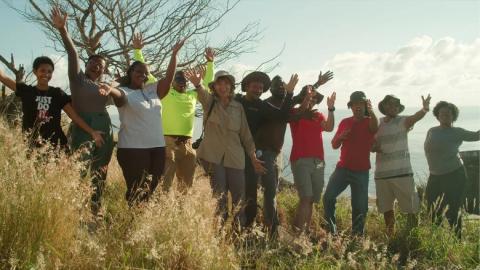
Johnella is one of the young women scientists in Antigua and Barbuda doing that job at EAG and leading conservation actions in two of Antigua and Barbuda’s Key Biodiversity Areas along with her childhood friend, Shanna Challenger. Friends since they met in primary school in 2000, they seemed destined to be colleagues. Initially, Johnella aspired to be a psychiatrist, while Shanna was on track to become a medical doctor. However, today, Johnella is the Redonda Ecosystem Reserve Coordinator, and Shanna is the Offshore Islands Conservation Programme (OICP) Coordinator. Both play key roles in the Critical Ecosystem Partnership Fund (CEPF)-supported project, “Accelerating Locally Led
Conservation Action in Antigua and Barbuda,” running from May 2023 to April 2026.
Established in 1989, the EAG has been at the forefront of conservation work in Antigua and Barbuda, and it is the country's oldest environmental non-governmental organisation. From restoring offshore islands and saving species from extinction to education, community engagement, and influencing environmental policy, the EAG works collaboratively to bring about environmental change in Antigua and Barbuda. Core to the EAG's work is an aspiration to have "a society with individual and collective responsibility to care for and value biodiversity and ecosystems for the long-term benefit of people and wildlife".
The CEPF-funded project is supporting conservation planning in the North East Marine Management Area and Redonda KBAs and strengthening conservation management for critically endangered species like the Antiguan Racer, Redonda Ground Lizard, and Redonda Anole, taking into account the impact of climate change on these species. The project also supports biosecurity monitoring for invasive alien species, building on work funded by CEPF during its first investment in the Caribbean Islands Hotspot between 2010 and 2016.
One of the first major activities of the project was a census of the Antiguan Racer. Once a top predator throughout Antigua and Barbuda, the population of this endemic snake dwindled after the introduction of Asian mongooses in the 1890s and other human pressures. Declared extinct in the 1930s, a few individuals survived on Great Bird Island, a small cay in the NEMMA that remained mongoose-free. In 1995, when only 50 individuals were found in the wild, the Antiguan Racer was called the ‘world’s rarest snake’. Although the population has since rebounded thanks to the conservation efforts of the EAG and partners, periodic censuses are needed to provide information about population trends, distribution, effectiveness of conservation efforts, and the impact of human threats. The data from the census is informing a long-term conservation action plan.