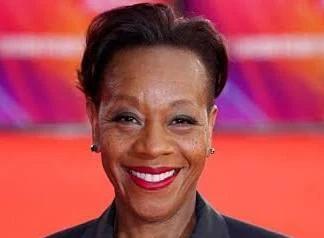
Marianne Jean-Baptiste’s story is often told through the lens of awards and accolades. But beneath the critical acclaim lies something deeper: a lineage rooted in the Caribbean, shaped by Antigua and Saint Lucia, and carried through South London with quiet resilience.
Born on 26 April 1967 in London to an Antiguan mother and a Saint Lucian father, Jean-Baptiste grew up in Peckham in a household shaped by migration, memory, and cultural inheritance. Her Antiguan roots were not ornamental — they were foundational. They carried the rhythms of Caribbean storytelling, the discipline of survival, and the insistence on dignity in spaces that did not always offer it.
Classically trained at the Royal Academy of Dramatic Art (RADA), she entered an industry where few women who looked like her were positioned at the center of narrative. When she collaborated with director Mike Leigh on Secrets & Lies (1996), her portrayal of Hortense Cumberbatch was not just technically brilliant — it was culturally seismic. She became the first Black British actress nominated for an Academy Award.
Yet even in that moment of triumph, she publicly confronted the racism embedded within the film establishment. Her Antiguan heritage — forged in histories of colonialism, resistance, and self-definition — made silence impossible.
Her career would move fluidly between continents. In the United States, she became a household name as FBI agent Vivian Johnson on Without a Trace, demonstrating a mastery of accent, authority, and psychological nuance. Yet even as she worked in Hollywood, her sensibility remained distinctly diasporic — layered, interior, grounded.
Jean-Baptiste is not only an actress but a writer, composer, and director. She recorded blues music, composed for film, and continued to build a body of work that resists confinement. Whether portraying Doreen Lawrence in The Murder of Stephen Lawrence or performing James Baldwin’s text on stage, she consistently chooses roles that interrogate power, grief, and endurance.
In 2024, she reunited with Leigh for Hard Truths, delivering a raw performance that earned her sweeping critics’ awards across New York, Los Angeles, and London. The achievement was historic — the first Black actress to win the major U.S. critics’ trifecta. Yet again, her work carried a particular gravity: women navigating depression, alienation, and invisibility — themes intimately familiar to members of the Caribbean diaspora negotiating belonging.
Now based in Los Angeles with her family, Jean-Baptiste remains an artist who bridges worlds — British and Caribbean, American and diasporic, classical and contemporary. Her Antiguan roots are not a footnote; they are the throughline. They shape her voice, her resistance, her artistry, and her refusal to be peripheral in her own narrative.
Her career is not merely a list of credits. It is a testament to migration, cultural memory, and the power of performance to reclaim space.